Topics in Middle East History
Chapter 9: The Byzantine Empire from 650 to 860
Copyright ©2010 by T. Pavlidis
The Aftermath of the Arab Conquests - The Two Sieges of Constantinople
The Roman empire that was left after the Arab conquest was a much smaller and poorer state. Still, its fate was better than that of the Persian Sassanid empire that had become part of the Arab caliphate. Figure 1 shows the extent of the Roman Empire about 50 years after the Arab conquests. (For more details see a map for the same period on p. 114 of [MW96].) The loss of Egypt was particularly painful because it was a rich agricultural land whose crops fed the population of the rest of the empire.
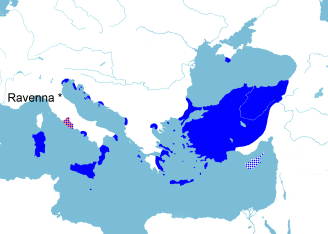 |
Figure 1: Lands
of the Roman Empire (in blue) in the early 700s. Not only Syria
and Egypt have been lost to the Arabs, but also most of what is
today Greece has been lost to Slavs and most of Italy to the Lombards.
The losses in Greece were temporary, but most of the other losses
were permanent. |
| Adapted from http://hobbit.ict.griffith.edu.au/wiseman/Roman/19Maps.html#754 | |
Heraclius had lived long enough (he died in 641) to see all the lands he gained from the Persians to be lost to the Arabs. The Arabs persisted in raids against eastern Asia Minor and the Aegean islands and in 674 they started a naval siege of Constantinople. There was a belief amongst the Muslims that the soldiers of the first army to besiege New Rome would have their sins forgiven. Gibbon observes sarcastically that the first Omayyad caliph, Moawiyah, was eager to take advantage of the opportunity "to expiate the guilt of civil blood" [EG, Chapter LII, vol. 5, p. 386]. When the winter approached the Arab fleet retreated in the peninsula of Kyzikos across the sea of Marmara from Constantinople (Gibbon refers to it, mistakenly, as isle). But the following summer the Arabs resumed the siege and the same story was repeated six more times. But the fortifications of Constantinople were too much for the Arabs and they gave up after losing 30,000 men. These included Abu Ayub, one of the companions of the Prophet. He was buried outside Constantinople and his grave was neglected but "discovered" after the Ottoman conquest in 1453 to become a shrine [ibid, p. 387].
A thirty years peace treaty was signed between the Romans and the Caliphate and an annual tribute was to be paid by the caliph to the Roman emperor every year. There was a lot of internal strife amongst the Arabs and that contributed to the caliph's agreement to pay tribute. (Recall that the battle of Karbala took place in 680, see Chapter 7.)
The last emperor of the Heraclian dynasty was Justinian II. He was enthroned in 685 (at age 16) but he proved a cruel emperor and he was deposed in 695 by one of his generals. His life was spared but he was punished by having his nose cut off and thus he became known as Rhinotmetus. He was exiled to the Cherson, a Roman possession on the Crimean peninsula (see map of Figure 1). There he befriended the Khan of the Khazars and he married his sister who was baptized with the name Theodora, apparently after the name of the wife of Justinian I. Eventually, he enlisted the help of the Bulgarian Khan and at the head of an army of 15,000 men attacked Constantinople and recovered the throne in 705. He carried out a cruel revenge on his enemies killing them with slow tortures but six years later he was overthrown and killed and so was his young son Tiberius [EG, Chapter XLVIII, vol. 5, pp. 81-85].
The leader of the revolt was the Armenian nobleman Bardanes who took the Greek name Philippikos. He was deposed and blinded by a military coup in 713 and his secretary became emperor under the name Anastasius II. He realized that an Arab attack would be forthcoming and started preparations for defense. However in 715 he was deposed by a military coup and succeeded by Theodosius III. Even if the Arabs had not planned to attack, the political turmoil in Byzantium encouraged then and a new Arab attack against Constantinople was launched in 717. The Muslim army consisted 120,000 Arabs and Persians, "the greater part mounted part mounted on horses or camels" [[EG, Chapter LII, vol. 5, p. 390]. In addition there was a fleet of 1800 ships. At the head of the huge force was the brother of the caliph, Maslama ibn Abdal Malik. A new military coup deposed Theodosius III (who then joined the clergy) and a general of Syrian origin became emperor as Leo III. He proved a very capable leader and repulsed the Arab attack.
A critical element in the Byzantine success was a new
weapon, which came to be known as Greek fire. (In Greek it is called υγρον
πυρ
Some historians consider the defeat of the Arabs in 718 to be of equal importance to their defeat in Poitiers/Tours in 732 (Chapter 6). In both cases the Arabs was pushed behind mountain ranges: the Taurus mountains in the East and the Pyrenees in the West.
While the Arabs were repulsed from the Byzantine capital they continue to cause problems elsewhere in the empire. They invaded Sicily in 826 but it took them over a century to gain complete control of the island and they stayed there until 1072 when they were expelled by the Normans. Around 826 the Arabs also invaded and captured the island of Crete and stayed there until 960 when they were expelled by the Byzantines. In 846 the Arabs sacked St Peter's church in Rome that was outside the walls of the city. In 904 the Arabs sacked Thessalonica. (Chronology from [MW96, pp. xvi-xx].)
The Isaurian Emperors
Leo III is known as the Isaurian and Gibbon attributes this to Leo's native province Isauria, a mountainous region in southern Asia Minor but most historians agree that he was Syrian from the town of Germanicea (today in the Turkish province of Kaharamanmaras) [WT97, p. 345]. He was familiar both with Arabs and their language [ibid]. The appellation Isaurian was apparently chosen because it sounded less foreign than Syrian. He founded a dynasty that lasted for 150 years and included several capable emperors.
However, the best claim to fame of the Isaurian emperors is their effort to abolish the worship of icons and those who followed that policy are known as Iconoclasts. Table 9.1 lists the Isaurian emperors marking the iconoclasts in bold.
| Table 9.1: ISAURIAN DYNASTY (Iconoclasts in bold) | ||
|---|---|---|
| Name | Years of Reign | Comments |
| Leo III | 717-741 | |
| Constantine V | 741-775 | Faced revolt by Artavasdes |
| Leo IV | 775-780 (died at the age of 30) | Wife Irene (from Athens) |
| Constantine VI | 780-797 (became emperor at age of 9) | Irene regent |
| Irene | 797-802 | Restored Iconolatry |
| The following are not descendants of Leo III but they are usually grouped with the Isaurians | ||
| Nikephoros I | 802-811 (killed fighting the Bulgars) | He was finance minister of Irene but he managed to depose her and become himself emperor. |
| Staurakios | July-October 811 (seriously wounded) | Son of Nikephoros. Abdicated because of his wounds and died in 812. |
| Michael I Rangabe | 811-813 | Brother-in-law of Staurakios. Abdicated and became a monk. His sons were castrated and forced to become monks. One of them became later patriarch under the name Ignatios. Persecuted the Athingans [1] |
| Leo V the Armenian | 813-820 | Restored Iconoclasm but was assassinated by Michael the Amorian. |
| Michael II the Amorian, ψελλος | 820-829 | Nicknamed the stammerer. Lost Crete and Sicily to the Arabs. [1] Succeded by his young son. |
| Theophilos | 829-842 (died at age 28) | Wife Theodora |
| Michael III | 842-856 (became emperor at age of 2) | Theodora regent |
| Final restoration of the worship of the Icons (March 11, 843) - Sunday of Orthodoxy | ||
| Michael III | 856-867 | emperor alone |
History of the Icon Controversy
Icons have been objects of veneration in Christian churches and homes for centuries. This practice is known as iconolatry and its practitioners as iconolaters. The systematic destruction of such icons is called iconoclasm and its practitioners are called iconoclasts. The terms are Greek and the first one can be translated as icon worship while the latter means icon breaking. The terms came into prominence during the reign of Leo III and that of his successors because they attempted to stop the practice of iconolatry. The term iconodules, meaning servants of the icons, is also used as a synonym for iconolaters.
The very fact that emperors became deeply involved in a religious issue is a reminder of how close the connection between church and state was. In modern times we are familiar with case where religious leaders try to influence state policy. But in the Byzantine empire the state leader took active part in religious issues.
Theologically, the argument against icons is based on the second Commandment "You shall not make for yourself an idol ... " and, indeed, early Christians did not use icons because they were considered as signs of idolatry and explicitly condemned by a synod that took place around 300AD [EG, Chapter XLIX, vol. 5, pp. 142-143]. However, things changed quickly in the following centuries and the worship of icons spread widely. Miracles were often attributed to them (and they still do today).
It is probably no coincidence that the worship of icons spread roughly at the same time as Christianity was legislated to be the only religion of the Roman Empire. Pagans who converted to Christianity needed something concrete to replace their idols and we have discussed this issue already (Chapter 4). Not all Christian churches went along, the Armenians allowed only a depiction of the sign of the cross but no other icons.
Jews and Muslims were quick to criticize icons worshiping Christians as idolaters and historians attribute such criticism as a motivating factor for Leo III (Gibbon [ibid, pp. 148-149], Whittow [MW96, p. 142]). One of the caliphs went as far as to order all icons in Syria to be destroyed, but ironically that act was later used by the iconolaters to support their own position (Gibbon [ibid, p. 147]).
A more important motivation might have been the interpretation of the Arab successes as divine punishment of the Christians for their idolatry. "The cities of Syria, Palestine, and Egypt had been fortified with the images of Christ, his mother, and his saints; ... In a rapid conquest .. the Arabs subdued those cities and these images; ... the Lord of Hosts pronounced a decisive judgment between the adoration and contempt of these ... idols" (Gibbon [ibid]). Whittow [ibid] and Treadgold [WT97, pp. 350-52] also support this view.
Treadgold [ibid] adds that in 722 Leo tried to force the baptism of all the Jews of the empire in order to appease the divine wrath and in 725 he issued a revised law code, the Ecloga or Selection (from the Justinian code). The new code was in Greek and much shorter than the Justinian code and it seemed to be motivated by a literal reading of the Bible. It outlawed abortion and limited the use of death penalty, but on the other hand it expanded it to cover homosexual acts and also expanded the use of mutilation as a punishment. Finally, it restricted the grounds for divorce.
Others point out that a major volcanic eruption at the island of Thera (modern Santorini) in 726 may have been seen as a sign of divine wrath [WT97, p. 352, CM02, p. 155]. Because of the ultimate defeat of the iconoclasts, history has been written by their opponents and we do not know what other political factors might have been involved.
Leo III proceeded cautiously. First he had a council of senators and bishops legislate that icons should be displayed at a proper height so that people could see them but not touch them. Later he banned their display completely (Gibbon [ibid]). The patriarch Germanus dissented quietly, but the Pope Gregory rejected openly the imperial edict. In 727 were revolts in Italy and Greece that Leo had to put down. Soon after there was a new Arab that reached and besieged Nicaea. One of the Byzantine officers smashed an icon of the Virgin and, for whatever reason, the Arabs withdrew. Leo declared that the destruction of the icon had saved the city [WT97, p. 352-53].
Leo replaced patriarch Germanus by Anastasius but the pope refused to recognize that appointment and also called a synod to condemn Iconoclasm as a heresy. In 733 Leo III tried to discipline the pope but sending a naval force but that was shipwrecked in the Adriatic. In order to punish the pope, Leo removed Sicily, Calabria, Greece, and the Aegean islands from his jurisdiction and placed them under the patriarch of Constantinople [ibid, p. 355]. Greece and the Aegean would remain for ever under the patriarch.
Leo died in 741 from dropsy, the first emperor to die in his bed in nearly a century. The year before he died he inflicted a smashing defeat on an Arab army, attributing it to a divine approval of Iconoclasm. He was succeeded by his son Constantine V who in 754 convened a council of 338 bishops that issued a unanimous decision that "image-worship was a corruption of Christianity and a renewal of Paganism" (Gibbon [ibid, p. 150], MW96, p. 144).
There was enormous opposition against the imperial policy. The leaders were clergy and monks with significant popular support. When Constantine V left the capital in an expedition against the Arabs his brother-in-law Artavasdes staged a coup, crowned himself emperor and restored the worship of the icons. Artavasdes reign was brief and Constantine came back to power but the incident is indicative of the strength of the opposition. The pope of Rome, who was beyond the reach of the emperor, was quite vociferous in his opposition to the iconoclasts and Gibbon considers such opposition as the start of the "papal monarchy" [ibid, pp. 151-154].
Eventually, the iconoclasts lost. When Leo IV (grandson of Leo III) died in 780 he was succeeded by his nine year old son Constantine VI with his mother emperor Irene serving as regent. Irene liked power and she did not want to give up the regency as her son reached legal age. Eventually, there was a coup against Constantine and in 797 Irene became officially empress. Constantine was blinded and he died from the injury. Immediately after her husband's death Irene had started working for the restoration of the worship of the icons. Historians think that this was a calculated move for consolidation of her power. Because all those who might be rivals to her power were iconoclasts, Irene looked for a power base amongst the iconolaters [EG, Chapter XLIX, vol. 5, pp. 174-175, MW96, pp. 148-150]. A new synod was called and the worship of the icons was made part of orthodox faith in 787. For more on Irene see http://en.wikipedia.org/wiki/Irene_(empress).
Irene was overthrown in 802 and she died a year later. Leo V became emperor in 813 and he banned the worship of icons again but the ban did not last long. The widow of another emperor was responsible for their restoration. Theodora became regent in 842 and the next year she ended iconoclasm for good. The occasion is commemorated by the eastern churches in the "Sunday of Orthodoxy" that falls on the first Sunday of the Great Lent. (In 2010, it was on February 21.)
A concise and reasonably accurate history of Byzantine Iconoclasm can be found in http://en.wikipedia.org/wiki/Byzantine_Iconoclasm.
What was Behind the Icon Worship Issue
Because the Iconoclasts lost we do not have their side of the story [MW96, pp. 155-159] and we can only surmise their true motives. Certainly the movement coincided with a major defeat of the Empire in the hands of the Arabs thus Iconoclasm can be seen as an effort for reform. We are told that amongst the "crimes" of the Iconoclasts were confiscation of monastic property and forced marriages for monks and nuns. We may speculate that Iconoclasm was, in essence, an attack on the practice and power of monasticism.
We may remark that Protestant churches reject both icon worship and monasticism, but that movement came several centuries after the Byzantine Iconoclasm. The Roman Catholic church allows both icons and statues while the Orthodox churches allow icons but not statues. The tradition of miraculous icons is widespread amongst the Orthodox but it is also encountered amongst Roman Catholics, especially in Italy. In the early 1990s a crying icon in a Greek church in Queens made the news. The then mayor of New York, David Dinkins, did not miss the opportunity to court the votes of the iconodules and visited the church to witness the "miracle."
Some writers credit the Protestant work ethic for the industrial revolution and economic development of the 19th century. It is true that the United Kingdom, Germany, Holland, the Scandinavians countries, the United States, Canada, and Switzerland had all a strong Protestant culture. France, while Catholic, had limited the influence of the church significantly after the 1789 revolution. (We may also note that even today the five problematic countries in the Euro zone, Greece, Portugal, Spain, Italy, and Ireland are either Catholic or Orthodox.) Many Greeks like to use that observation as the basis for arguing that if the Iconoclasts emperors had succeeded, the Byzantine empire would have fared much better and the industrial revolution might have started in the East. However, the parallel to the Protestant Reformation is disputed by some scholars who also claim that Iconoclasm was not the dominant issue that other historians claim to be (Patricia Karlin-Hayter in [CM02, pp. 153-162]).
Gibbon provides another argument against drawing too close parallels with the Protestant Reformation by stating that "the seventh and eighth centuries were a period of discord and darkness". He describes the Iconoclasts as anti-intellectuals and enemies of antiquity and he adds that they abolished the royal college and burned its library. It was only under Michael III and by the initiative of his uncle Caesar Bardas that a school was opened in mid-ninth century [EG, Chapter LVIII, vol. 5, pp. 482-483]. Treadgold describes in some detail the decline of education under Heraclius and the Isaurians [WT97, pp. 395-399] and points out that most religious writers in Greek lived in the Arab Caliphate [ibid, p. 398].
Developments in Other Fronts
(The material of this section is from Whittow [MW96, pp. 279-285].)
The West had seen the rise of Frankish kingdoms and Charlemagne reigned from 768 to 814. He crowned by the Pope as Emperor of the Romans in 800, during the reign of Irene in Constantinople. This was a direct challenge to the Byzantines and there was a period of warfare between the two Roman emperors but eventually a peace treaty was signed and Michael Rangabe recognized Charlemagne as Emperor (but not of the Romans). The Franks received the Istrian peninsula (around Trieste) while the Byzantines kept Venice. This was also the time of the first schism between the pope of Rome and the patriarch of Constantinople but we will discuss this topic together with the second and final schism in Chapter 11.
Avars, Slavs, and Bulgars have been making inroads in the Balkan peninsula. The Avars were eventually defeated first by Charlemagne and then by the Bulgars who established a qaghanate around the lower Danube. A Serbian state appears in the ninth century but it was the Bulgars that gave the Byzantines real trouble. The Bulgars were a Turkic people from the steppes but their subjects also included Slavs and Greek speaking "Romans". In 864 the Bulgarian qaghan Boris was under the threat of the Byzantine army and agreed to be baptized as the emperor's godson. The story of the Bulgar conversion is quite intriguing because the Bulgarian king drove a hard bargain with the Byzantines by playing them against the Pope of Rome. After his conversion he expelled the Greek priests and asked the pope and the German king for missionaries. But that did not work well. Germany was too far away and the pope had no army, so Boris came to terms with Byzantine extracting the concession of an autonomous Bulagarian church under an archbishop.
First Posted: February 23, 2010. Latest Revision: November 14, 2010.
Notes
- The Athingans were Christians of Cappadocia who followed some Jewish practices. Michael I started killing them (as well as another sect, the Paulicians who believed that the God of the Jewish Bible was evil). The killings stopped when the abbot of Studius (a major monastery) insisted that the heretics should first be given the chance to repent. On the other hand Michael II came from an Athingan family. [WT97, p. 429-433]. Finlay ["History of the Byzantine Empire"] lists several opinions about Michael II background, including one that he was the son of a converted Jew. The name of the sect comes from the Greek "Do not touch". Ironically the word means Gypsy in formal modern Greek.